

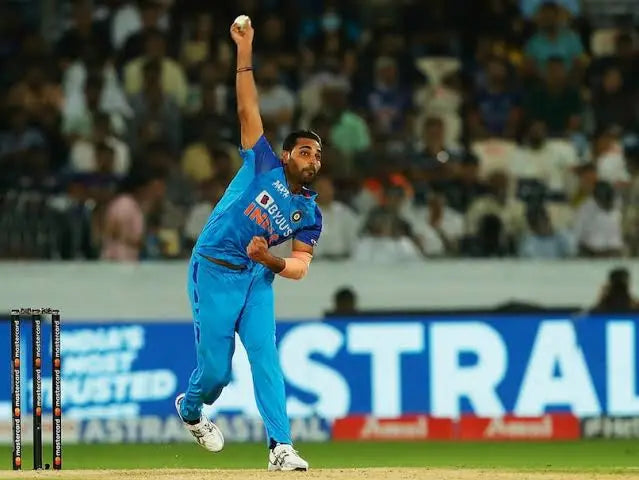
It is rightly said that pacers are born and not made. They are gifted with a natural ability to bowl fast. They are the ones who start the bowling innings and they are the ones who conclude the innings as well, hence they play a vital role in deciding the course of the game. However, in the pace department too, we can find a lot of diversity. Firstly, there are pacers, gifted with natural speed, who can bowl really fast. They can hit the deck hard and extract pace from the pitch. Then comes the pacers who are slower in terms of speed, but they have the ability to swing the ball. Both these types have their own strengths and limitations and thus, they are effective in different kinds of conditions. Apart from diversity in speed, there is a lot of diversity otherwise too. For example, both Jasprit Bumrah and Mitchell Starc are fast bowlers, but both are different in terms of their line, length, etc. Thus, each bowler is special in their own way, having proficiency in different departments.
 P
PToday, in this blog by ZAP cricket, we will discuss pace bowling and how a bowler can improve his/ her skill as a pacer by using these suggested ways.
Speed work
Speed work or sprinting can help a lot with gaining the required rhythm. Fast bowlers should plan out their session in such a way that they cover speed work sessions regularly. This will help them in bowling fast as they will have better and more synchronised rhythm. Players like Hardik Pandya, Josh Hazelwood regularly do spring training and we all can see the results of their grind.
One of the most basic sprinting techniques is tempo running. A player has to set two cones placed 20-30m apart. Now, they need to sprint from cone A to B. For recovery, they shall walk back, that is, from cone B to A. One can do 3-4 sets with 10 repetitions each. Apart from that, one can also do shuttle running, long sprints (100m), etc. These running drills can also help a pacer in achieving peak fitness. For better results and improved output, it is recommended to train under a professional as they can help in providing the personalised plans, as per the requirements of an individual.
Balance between ground training and weight training
Weight training will help a pacer to maintain/enhance their strength. Hence, a balance should be maintained between ground training and weight training. This will create optimum strength and explosiveness in the muscle. Key muscles used for bowling are hamstrings, quadriceps, lower back and shoulder. So, the prime focus should be to maintain strength of these muscles.
Common exercises that can be included in a player’s routine to cover these muscles are: squats, lunges, deadlifts, leg curls, shoulder press, etc. Obviously the weight and intensity of the workout will vary as per the individual but one can cover these basic strength exercises to build a pacer like stength. For better results, it is important to work under a professional as they can help in faster and better results and can also help in eliminating the risk of injuries.

Diet with good electrolytes
Diet plays a vital role in gaining strength and in faster recovery. Hence, one can never undermine the importance of a balanced diet. A medium pacer should take foods that contain a good amount of protein and fat. Along with that, they should be mindful in consuming sufficient electrolytes so that their body recovers fast and they are fully hydrated. A player can never achieve best results on the ground with inadequate calorie consumption and poor hydration.
It shall be noted that diet plans should be customized and constructed as per an individual’s body type and routine. Hence, it is recommended players should consult a dietitian for optimum results.
Bowling in nets/ spot bowling/ bowling in matches
The more number of overs under an individual's belt, the greater the accuracy they achieve. Hence, one shall bowl regularly in nets, open nets and matches. Bowlers can achieve clarity only by practicing under different scenarios and in different conditions. This clarity will ultimately help in proper execution in professional matches. Practicing with both new ball and old ball is important.
Along with all this, one can regularly practice spot bowling as it will help in bowling in right lines and lengths. One can use markers to highlight their bowling zones and then they can practice hitting that territory. It shall be noted that cricket is evolving and is becoming more batsman friendly, hence, players should practice different variations as well, so that can survive in slog overs.
Also check: Variations in pace bowling
Focus on line and length instead of pace
It doesn’t matter if a player is bowling at 150kmph or 135kmph, what really matters is how effective they are with your line and length. A fast bowler with lethal pace but erratic spot is less useful than a medium pacer who is bowling in the right areas all the time. Hence, more emphasis should be given on bowling right on line and length rather than on bowling fast. There's a reason why players like Bhuvneshwar Kumar have been so successful for a very long time. He always made sure that he bowled in the right areas which always compensated with his lack of pace.
Nowadays, young players are more keen on bowling at higher pace and in order to achieve that, they either get injured or are very inconsistent with spot. Hence, this thing should be made in clear in mind that they need to be consistent with the spot first!

Drills that can help in improving bowling
There are many drills that one can include in their routine to become a better pacer. These drills focus on an individual body movement and recurring practice of these movements will help in becoming a better pacer. For example, one can specifically focus on wrist movements or specifically on loading and jumping.
Apart from that, some people have a different action and that restricts them from performing well. Thus, need to rectify that first. For instance, if a pacer is having trouble in controlling their wrist position, they can include basic wrist drills in their routine. Similarly, if a pacer is having trouble with alignment of non bowling arm, they can add drills to control the same. It is better to learn from your coaches and adapt the same drills in your practice sessions!

Taking adequate rest
Taking adequate rest and managing workload is equally important. Quality shall be maintained at all times to become a great pacer. Bowling large spells without rest and recovery can invite injuries. Hence, to stay injury free, one has to take rest as well. There is no point of bowling many overs and not taking rest, that will only build injuries and such injuries can even hamper a player’s career in the long run. So, smart work is as vital as hard work. After all, there is a reason why BCCI emphasis so much on recovery and workload management. They have the best coaches and physiotherapists under their panel, but they understand the importance of workload management.
Conclusion
With this comprehensive guide, we tried to explain the workload that is needed to become a better pace bowler. We tried to narrow down the do’s and don’t, so that you can improve as a player and have a long career without any injury. For better understanding and better guidance, it is recommended for you to consult a professional and have one on one sessions with them. This will help you in timely rectification. Keep working hard and keep working on the rhythm, because eventually fast bowling is all about rhythm!
FAQs
Q: How can I reach 150kmph?
Follow the above points and you’ll improve your pace.
Q: What is the average pace in women’s cricket?
The average pace in women’s cricket in 105-110 kmph.
Q: What is better in-swing bowling or out-swing bowling?
Depends on the conditions in which you are playing.
Q: How to start pace at young age?
Practice spot bowling regularly.
Share:
10 interesting facts about cricketers
Scenic cricket: exploring the most picturesque grounds in the world