

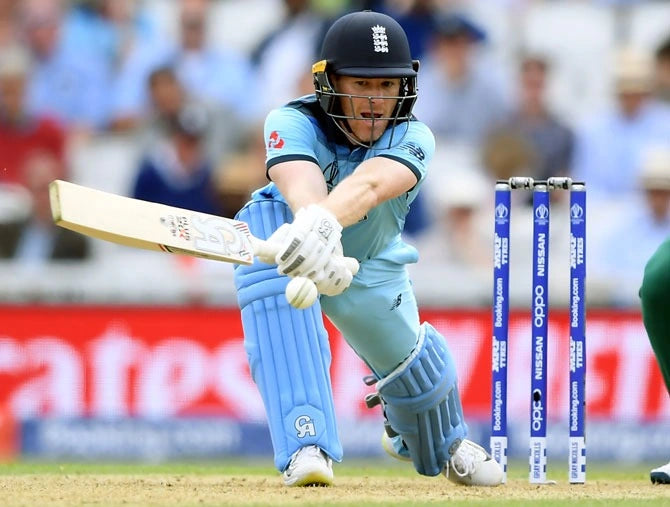
Cricket is a sport that demands a diverse range of batting techniques to thrive in different game situations. The reverse sweep can be a powerful way to manipulate the field when conventional scoring areas are well protected. A well-timed reverse can force the captain to rethink placements, but it is still a high-skill option and can be countered with smart bowling and field changes. The stroke's ingenious nature lies in its ability to change the direction of the ball, making it challenging for the fielding side to adapt quickly. So, in this chapter of Learn with ZAP, let’s understand how to play the reverse sweep cricket shot and be a pain in the lives of bowlers.
Last updated: October 6, 2026

Reverse sweeps are cross-batted sweep shots that are played in the opposite direction from a standard sweep in cricket. The ball is swept in the offside, towards the direction of the third man or the backward point rather than being swept towards the square leg. It has become an important scoring option for many modern batters, particularly against spin.
Players such as AB de Villiers, Glenn Maxwell and Rishabh Pant have even used variations of the reverse sweep against pace. For most players, though, it is a more natural option against spin, where there is usually more time to set the body and bat path.

Credit: Hindustan Times
Remember that Rishabh Pant reverse sweep against James Anderson? How outrageous was that! It was the first ball of 83rd Over on Day 2 of the England test at the Narendra Modi Stadium. James Anderson came in running fresh to bowl the first ball, and what Rishabh Pant did next was super audacious. Rishabh who was already smacking English bowlers all around the ground, reverse swept Anderson, and hit it over the slips for a four. What makes it even more commendable was the fact that it was the second new ball, with Anderson, one of the best new ball bowlers in the world, delivering it. Even the opposition captain Joe Root couldn't believe the shot and was left smiling. Pant got to his hundred in that match, but was later caught out out by Root of Anderson's bowling. The shot still is fresh in all cricket fans in mind, and shows how confident Rishabh is with the bat.
You can get that confidence too, just get a ZAP Cricket bat and own the pitch with your confidence.
Though the shot appears fun to play and feels easy when you’re on the other side of the tv but it with the bat in your hand is quite a difficult task. Here’s a step by step guide of how to do it perfectly:
One of the most crucial components of batting is body equilibrium. Body balance is crucial and essential. Stay in a comfortable base that is neither too wide nor too narrow. Hold the bat at its outside edge while remaining attentive and posing your head correctly.
With the stance, knowing how you hold your bat well and being in a balanced position is super important.

Credit: The Times
| Situation | ZAP's view |
| Spinner with a packed leg-side field | Useful way to open an off-side scoring area |
| Good balance and clear read of length | Better time to commit to the shot |
| Very full or very short delivery | Usually higher risk because contact can become difficult |
| Early in the innings before reading the pitch | Use caution rather than premeditating |
| Against pace | Advanced option for highly skilled players, not a default shot |
As said earlier, the shot can mainly be played to spin bowling. Usually those ones pitched at the good length outside the off stump.
It is not a good idea to play it unless you are aware of how the pitch is playing and the actions of the bowler. It would not be difficult for you to lose your wicket if the ball stayed low. This is something you definitely want to avoid.

Credit: Playo
Finally, once you’ve understood the ball well and it’s the perfect line and length, it’s time for you to play the shot.
The reverse sweep gives bowlers, fielders, and the fielding captain nightmares. It interferes with a bowler's line and length, and there is no way to make it up. The logical conclusion is that a right-hander should play it like a left-hander, and vice versa. If there's a complete change of grip and not only the way you swing your bat, the shot will turn into a switch hit, which is even more aggravating for the bowling side.
You cannot always play the reverse sweep if you feel there’s too much pressure because of the fielding team. The stroke is a makeshift way of scoring runs and releasing pressure, so you cannot completely depend on it. There are certain things to always know so that you avoid mistakes.
Q - Is the reverse sweep a reliable shot to depend on for scoring runs?
It can be an improvised method of adding runs and relieving pressure and also be beneficial when used correctly. But you should not rely primarily on it and instead play it carefully depending on the circumstances of the game and the bowler's deliveries.
Q - What is the difference between a reverse sweep and a switch hit?
If you are a right-handed batsman, you play a switch hit by switching the positions of your upper and lower hands and acting as if you were a left-handed batsman (or vice versa if that is the case).
You don't change the grip on your hands when hitting a reverse; you simply rotate your bat.
Q - Who was the first cricketer to play reverse sweep?
Even though it efficiently dismantles the field positions, this stroke is seen as an unconventional shot by purists of cricket. Nevertheless, it can be a useful shot to play. Mushtaq Mohammed, a Pakistani batsman, introduced it to widespread use in the 1970s.
Share:
The Inspiring Career of Mithali Raj
Narendra Modi Stadium - The Largest Cricket Stadium in the World